Koibe Shewo
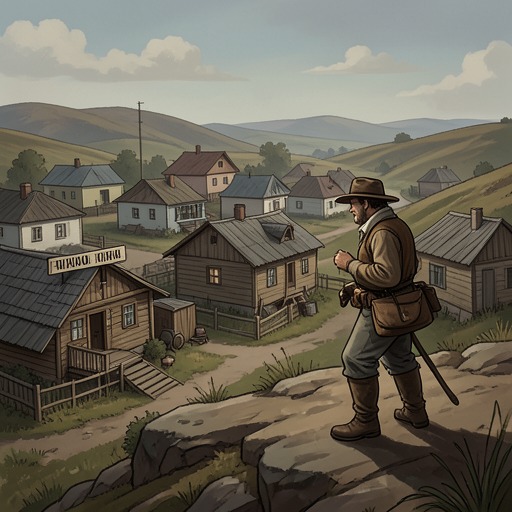
Grey BeesKuybyshevo, also called Albat, is a Crimean settlement that gives Sergey Sergeyich’s flight with his bees a destination and a human purpose. He knows it through directions from a food seller near Bakhchysarai, and arrives seeking the beekeeper Akhtem, a fellow convention-goer whose fate he does not yet know. The place is therefore more than a point on the road: it is where an intended refuge for the bees becomes a search for a missing friend, and where the novel joins displacement to the fragile, practical work of sustaining life.
Setting and Route
Before setting out, Sergey Sergeyich tells border officials that he is going to Crimea for his bees, not for himself. He has an address for a beekeeper near Bakhchysarai, but the evidence gives no street address or precise distance to the home he seeks. His explanation makes the journey’s immediate purpose concrete: the bees need somewhere to fly, forage, and make honey in peace.
Kuybyshevo enters the journey through a brief exchange at the roadside. Beside his Lada, Sergey Sergeyich buys and eats his first samsa, then asks the seller how to get there. The seller recognizes the destination by its other name, Albat, and directs him through Bakhchysarai toward a Yalta sign, then along that road for about twenty kilometres. The directions make the two names part of the lived geography of the route rather than an abstract map label.
Arrival and Search for Akhtem
Sergey Sergeyich’s destination is also tied to Akhtem, whom he expects to find in the region. At the house where he knocks, a woman in black asks whether he means Akhtem and then reacts as though he does not know what has happened. Sergey Sergeyich, looking between her and a dog barking beside its kennel, asks what she means and where Akhtem is. The scene makes arrival a moment of uncertainty: he has reached the person and place he came to find only to discover that his knowledge is incomplete.
He explains the connection that brought him there. He and Akhtem met at a beekeepers’ convention in Sloviansk, shared a room at a boarding house, and were both beekeepers; Sergey Sergeyich has come with his hives. The woman’s glance back toward the gate and her guarded questions give the meeting an uneasy quality before she supplies what he needs to know. Kuybyshevo thus stands at the point where a plan for practical relocation intersects with the novel’s account of Akhtem’s disappearance.
Bees, Work, and Displacement
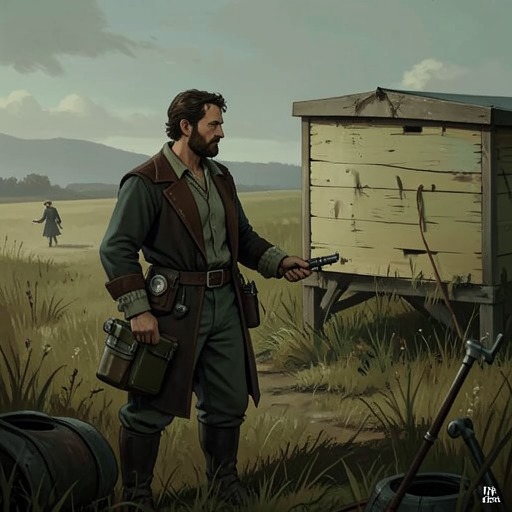
The novel repeatedly grounds Sergey Sergeyich’s movements in the requirements of bee care. His departure from home is planned around the weather and the hives’ vulnerability in transit: he closes their entrances, loads them one by one onto a flatbed trailer, covers them with a tarpaulin, and straps them down. He carries jars of honey as well, treating it as a dependable store of value. The journey toward Kuybyshevo is not an uncomplicated escape; it depends on transporting living colonies without letting them scatter or overheat.
That practical knowledge shapes his understanding of the bees as fellow inhabitants rather than passive possessions. In summer he hears the bee-wings among the louder birds and takes their sound as proof both of their health and of his own presence. He calls himself their representative, while holding that their purpose—to gather nectar and pollen—is their own. He tends their health, drives wasps from the hives, uncaps combs for honey, and collects wax and pollen; he does not claim authority over the bees’ internal life. The destination matters because their continued work requires a place in which they can forage and live.
A Landscape Read Through Bee Life
Sergey Sergeyich’s observations of the hives also give the novel a way to test human social ideas against animal behavior. At the entrance of a hive, he watches guard bees push weakened drones out before cold weather, when the colony would otherwise spend honey and syrup on them. He interprets the scene through the contrast between worker bees, who gather pollen and build combs, and drones, whom he sees as consumers. His conclusion reflects his own judgment of human life as much as a neutral account of nature: he finds nature’s apparent wisdom intelligible, then measures people against it, usually to their disadvantage.
The bees’ needs are described in precise, recurring terms. They maintain a temperature of thirty-seven degrees inside their hives, even in winter, and cannot sleep through the cold because they must keep themselves warm. This knowledge links an earlier conversation about winter care to the larger journey: Sergey Sergeyich’s protection of the colonies is a continuing obligation, not a passing reason invented at the border. At Kuybyshevo, as elsewhere, the novel keeps the bees materially present—as bodies, workers, and communities—while allowing their social organization to prompt reflections on people.
Place in the Novel
Kuybyshevo’s narrative significance lies in the meeting of several kinds of vulnerability. It is a destination chosen for the bees, a place reached by improvised road directions, and the setting for Sergey Sergeyich’s first encounter with the news surrounding Akhtem. The bees’ arrival depends on his detailed care, while the human search that accompanies it exposes how little he knows about the friend he has come to find.
The place also belongs to a broader pattern in which movement does not produce simple safety or return. Sergey Sergeyich’s home had seemed to him a fortress until departure taught him that it, too, had sheltered him. The move toward Crimea relocates his apiary but cannot restore an undisturbed life: even the bees’ ordinary labor, their gathering, flight, and seasonal survival, unfolds amid human conflict and separation. Kuybyshevo therefore marks both a hoped-for refuge and the point at which that hope encounters the unresolved human realities of the story.